Sanjaykumar Bansal
The manufacturer was using Natural Rubber lid gaskets supplied by an external vendor.
The gasket worked.
But the system didn’t.
They were facing:
✔ Inconsistent gasket quality
✔ Long and unpredictable lead times
✔ No control over production
✔ No internal quality ownership
Every issue required vendor coordination.
Every delay affected dispatch.
The Real Challenge
They wanted to move production in-house. But they could not compromise on:
• Sealing performance
• Flexibility
• Food safety
• Durability
The question was not:
“Can we use TPE?”
The question was:
“Can TPE match rubber performance — and improve production control?”
What Was Evaluated First
Instead of choosing a grade immediately, the performance requirements were decoded:
Only after defining performance did material development begin.
• Required hardness range
• Compression set behaviour
• Sealing under load
• Contact safety standards
• Injection moulding feasibility
The Material Developed
A customized TPE compound was engineered to:
Now the gasket could be produced in-house.
• Match Natural Rubber flexibility
• Deliver reliable sealing
• Be injection mouldable
• Be recyclable
• Meet food-grade standards
• Be RoHS compliant
Before
-
Outsourced rubber
-
Variable quality
-
High dependency
-
Long lead time
After
-
In-house injection moulding
-
Stable quality
-
Production control
-
Reduced supply risk
The Impact
✔ Shift from outsourced to in-house production
✔ Improved quality consistency
✔ Reduced lead time
✔ Higher productivity
✔ Regulatory-compliant solution
But the real shift?
They gained control over a critical component.
TPE did not just replace rubber.
It enabled:
Production ownership.
Process stability.
Regulatory clarity.
Scalable manufacturing.
If you're evaluating rubber-to-TPE conversion or planning in-house production.
A diagnostic discussion can help identify risks before you scale.
EPDM/Natural Rubber to TPE Conversion for Two-Wheeler Blinker Stay
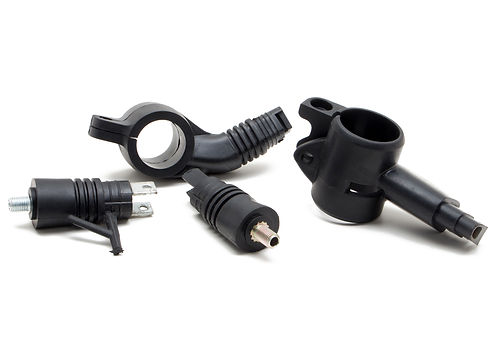
Industry: Automotive (Two-Wheeler)
Application: Blinker Stay
Challenge
The blinker stay was earlier made from EPDM or Natural Rubber. Although the product life was acceptable, it suffered from breakage issues and could not meet all technical requirements. Production was outsourced, leading to poor quality control, frequent supply delays, and low reliability.
Solution
A customized TPE material was proposed that is injection moldable, recyclable, RoHS compliant, and UV resistant. The TPE formulation was engineered to achieve technical properties not possible with EPDM or Natural Rubber, while enabling in-house manufacturing.
Results
-
In-house production with better quality control
-
Higher productivity and stable supply schedules
-
Elimination of breakage issues at end-user level
-
Improved technical performance and durability
-
RoHS-compliant and UV-resistant solution
Key Takeaway
TPE provided a stronger, compliant, and high-productivity alternative to EPDM and Natural Rubber for two-wheeler blinker stay applications.